Probuild. Clough. Porter Davis. The collapses made the news. But most of the money disappears quietly, on live projects, from clauses in contracts nobody read.
In March 2022, Probuild collapsed. It was one of the largest construction failures in Australian history. Five billion dollars in unfinished projects across the country. Cranes frozen mid-swing on tower sites in Melbourne and Sydney. And somewhere north of three hundred million dollars owed to subcontractors who would never see it.
Sparkies. Plumbers. Concreters. Formworkers. They'd done the work. Submitted their invoices. Some had been waiting 60 days for payment. Others had tens of thousands in retention money sitting in Probuild's accounts, money they'd earned and never received, now vaporized into the insolvency pool alongside everyone else's claims.
Most of them got nothing. Some got cents in the dollar. A few lost their businesses entirely.
And then, ten months later, it happened again.
In December 2022, engineering giant Clough went into administration. Trade creditors and subcontractors were owed $66.6 million. Workers were owed $12.2 million in unpaid entitlements.
Three months after that, Porter Davis Homes folded. One hundred and forty-seven million dollars in debts. Roughly 2,000 creditors. Over 1,700 homes left unfinished across Victoria and Queensland. Subcontractors who'd been working through Christmas found out in March that the money wasn't coming.
These weren't freak events. The numbers had been screaming for years. Nobody wanted to look at them.
ASIC's annual insolvency data shows 2,975 construction companies went insolvent in the 2023-24 financial year. That was a 28 percent increase on the year before. Construction now accounts for roughly 27 percent of all company insolvencies in Australia, while the industry makes up about 8 to 10 percent of GDP. One in four company failures, from an industry that's less than one in ten of the economy.
The Reserve Bank of Australia dedicated a section of its April 2025 Financial Stability Review to the spike in construction insolvencies, which have blown past pre-pandemic levels. UNSW researchers titled their October 2024 analysis "Construction nightmares."
None of these collapses happen in isolation. They happen inside a web of contracts. The clauses in those contracts determine who gets wiped out and who walks away. And almost nobody reads them before signing.
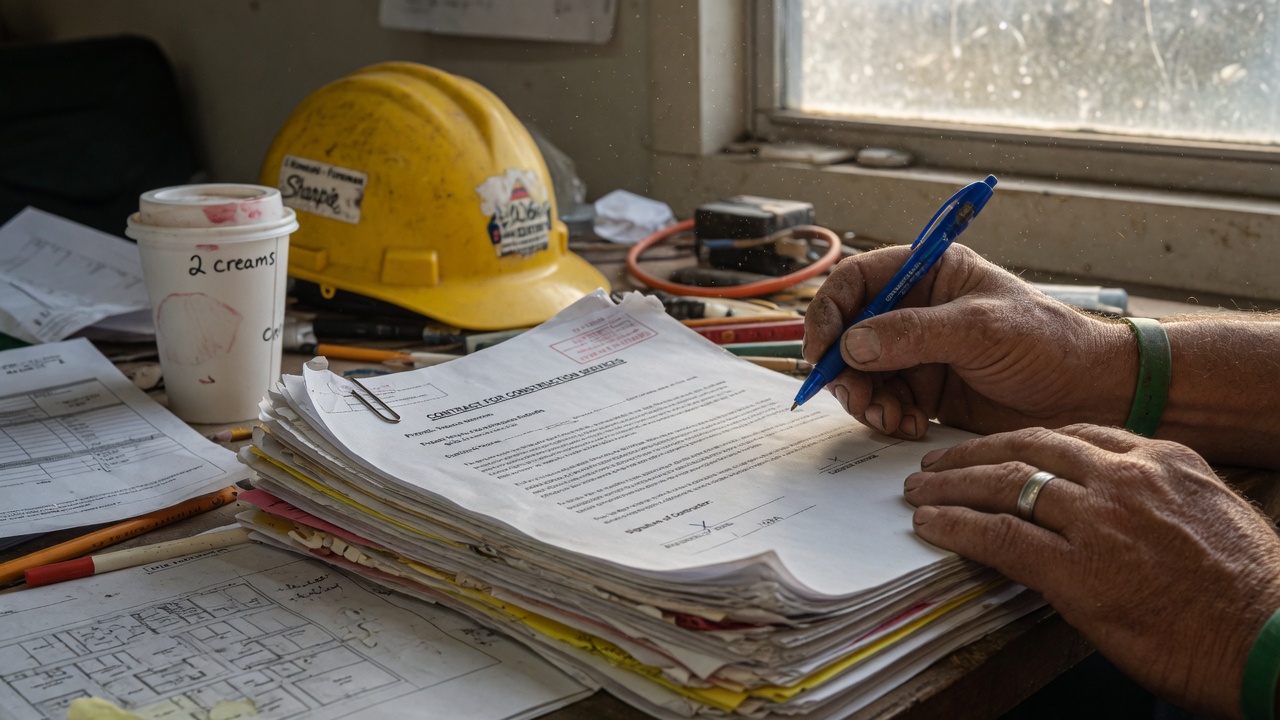
When a subcontractor signs a contract with a head contractor, the document is usually 20 to 40 pages of dense legal language. Most subbies flip to the scope, check the price, maybe glance at the completion date, and sign. The clauses that will actually hurt them are buried deeper. And they only become visible when something goes wrong.
Retention is simple enough on paper. The head contractor withholds a percentage of each invoice, typically 5 to 10 percent, as security. If you don't finish the work or it's defective, they use the retention to fix it. When you hit practical completion, you get it back.
Except you often don't.
Industry estimates put the total retention money held across the Australian construction sector at roughly $18 billion at any given time. That money sits in head contractors' bank accounts, mixed in with their operating cash, their payroll, everything else. Not ring-fenced. Not held in trust, in most states. Just sitting there until the builder needs it for something else. Or until they fold.
When a builder goes under, retention money gets swallowed into the insolvency pool. Subcontractors become unsecured creditors, which means they're behind employees, behind the ATO, behind the banks, behind the receivers and their fees. Whatever scraps are left get divided among every other unsecured creditor fighting for the same pool. Fifteen cents in the dollar is considered a good result.
Some states have tried to fix this. Queensland requires retention to be held in trust accounts, separate from the builder's operating funds. NSW has retention money protections under its security of payment laws. But Victoria, South Australia, Tasmania? Nothing mandatory. The law is essentially the same as it was 20 years ago.
The average subcontractor has around $40,000 in retention outstanding at any time. For a small sparkie or plumber running on 8 to 15 percent margins, that $40,000 might be the entire profit from their last two jobs.
Liquidated damages clauses set a fixed daily rate that the head contractor can deduct from your payments if you're late. Five hundred dollars a day. A thousand. Sometimes more. The idea is that it's a pre-agreed estimate of the loss the head contractor will suffer from delays. It sounds reasonable until you're three weeks behind schedule because the concreters were slow and site access was delayed and the inspector didn't show up for a fortnight.
The maths is blunt. On a $180,000 electrical fit-out with $800/day in LDs, a six-week delay costs $33,600. Your profit margin on that job might have been $20,000. You've now lost money on work you completed.
The worst contracts don't cap LDs. There's no ceiling. An eight-week delay at $1,000/day is $56,000. Some subbies have copped six-figure LD deductions on a single project. And because it's in the contract, it's enforceable. The head contractor doesn't have to prove they actually lost that amount. That's the whole point of liquidated damages: the number was agreed in advance.
DLA Piper's analysis of Australian court approaches to LDs notes that while the penalty doctrine can void clauses that are extravagant or unconscionable, the bar is high. If the daily rate was in the contract and you signed it, courts generally enforce it.
Pay-when-paid clauses say the head contractor doesn't have to pay you until they've been paid by the principal. If the developer doesn't pay the builder, the builder doesn't pay you. Your work, your materials, your crew sitting idle for weeks. Not your problem? It is now.
These clauses are technically illegal in every Australian state and territory. The High Court confirmed it in Maxcon Constructions v Vadasz [2018]. Security of Payment legislation across the country explicitly prohibits them.
They persist anyway. Not always in their naked form. Sometimes they're dressed up as conditional payment mechanisms, or as clauses that tie payment milestones to upstream approvals, or they're buried in the fine print about when a payment claim becomes "due." The wording changes. The effect doesn't. Your money depends on someone else's money, and you have no control over either.
An indemnity clause says you'll cover the head contractor's losses in certain situations. A narrow indemnity is reasonable: if your plumber floods a level because they connected the wrong pipe, you should wear that cost.
A broad indemnity is something else. It can make you liable for losses arising from the head contractor's own negligence, or the negligence of other trades, or events completely outside your control. Legal analysis from Gibbs Wright Lawyers and Piper Alderman highlights that poorly drafted indemnity clauses are among the most financially dangerous terms in Australian construction contracts.
Some of these clauses are so wide that your public liability insurance won't touch the exposure. You've agreed, on paper, to be personally responsible for losses that could dwarf the value of your contract. And indemnity obligations often survive the end of the contract itself. The job's finished. The defects liability period is over. But the indemnity? Still live. Still enforceable. Still waiting.
A personal guarantee means you, the actual human being, are liable for the debts and obligations of your company under the contract. If your Pty Ltd goes under because a project went sideways, the head contractor's lawyers can come after your personal assets. The car. The savings account. The house your kids sleep in.
Most subbies sign these without blinking. The head contractor says it's standard. Sometimes it is. But there's a difference between guaranteeing that you'll show up and do the work, and guaranteeing $500,000 in potential liability exposure with your family home as the implicit security.
The construction lawyers who write about this topic use the same language repeatedly: subcontractors should treat personal guarantees as a last resort, never as routine. But on a Tuesday morning when you need the job and the contract's sitting on the ute's dashboard, routine is exactly what it becomes.
Time bar clauses set a deadline for making claims. If you encounter a variation, a delay, a site condition that wasn't disclosed, you typically have to notify the head contractor within a fixed number of days. Miss that window and your claim is gone. Not reduced. Gone.
Some contracts give you 28 days. Some give you 14. Some give you 7. And the clock starts ticking from the moment the event occurs, not from when you realised what happened. You might not discover a latent defect or a scope change until weeks after the relevant date. By then, the time bar has closed.
It punishes the busiest people the hardest. A subbie running three jobs simultaneously, managing a crew of six, chasing an overdue payment on the last project while arguing with a supplier who shipped the wrong fittings. That subbie is not sitting in an office with a calendar open, diarising contract notification periods. They're on site. They'll realise they had a claim about three weeks after the deadline to lodge it.
Australia has Security of Payment legislation in every state and territory. It was supposed to solve this. Rapid adjudication. Statutory payment timeframes. Progress payment rights that override unfair contract terms. The Senate Economics References Committee ran a full inquiry into insolvency in the Australian construction industry back in 2015. Eleven years ago. The problems they identified then are the same problems killing subbies now.
The Murray Review, finalised in 2018, recommended national harmonisation of these laws. The states all do it differently. The timeframes don't match. The adjudication processes don't match. The rules about which contracts are covered don't match. A subcontractor working across state borders is navigating multiple legislative frameworks, each with their own traps. The Commonwealth Government didn't formally respond to the Murray Review until March 2025. Seven years.
In November 2023, the Victorian Parliament's Environment and Planning Committee completed its own inquiry into employers and contractors who refuse to pay subcontractors. Twenty-eight recommendations. The Victorian Government endorsed them in October 2024. Implementation is ongoing, which in government language means it could be years.
There is one recent change that matters. In November 2023, the unfair contract terms regime was expanded to cover businesses with under 100 employees or less than $10 million in turnover. Penalties now include fines up to $2.5 million for individuals and up to 30 percent of turnover for corporations. Pinsent Masons' analysis found this applies directly to the kinds of lopsided clauses that have been standard in construction subcontracts for decades. Broad indemnities, uncapped LDs, one-sided termination rights. All potentially void now.
Most subbies have no idea. The broad indemnity they signed last month might already be unenforceable. The uncapped LD provision could be challenged. But nobody told them, and by the time they find out, they've already worn the loss.
Probuild owed subcontractors over $300 million. Clough owed $66.6 million to trade creditors. Porter Davis left $147 million in debts across roughly 2,000 creditors. Those are the ones that made the news. Below them sit thousands of smaller failures every year, each one leaving a trail of unpaid invoices, lost retention, and subbies who did the work and won't get paid.
The collapses get the headlines but they're not where most of the money disappears. That happens quietly, on live projects, where subbies are copping LD deductions they can't fight, waiting months too long to collect retention, carrying indemnity exposure they don't understand, and missing time bars on claims they didn't know they had.
Nobody aggregates these losses. There's no central register of how much money Australian subcontractors lose each year to unfair contract clauses on projects where the builder didn't even go bust. It's invisible. A subbie cops a $15,000 LD deduction on a job in Parramatta. Another one loses $8,000 in retention because the builder stretched practical completion by four months. A plumber in Brisbane signs a personal guarantee without reading it and spends two years paying off a debt that wasn't his company's fault.
Multiply that across 400,000 registered subcontractors and the total is staggering. But it doesn't show up in any report because it's not one disaster. It's tens of thousands of small ones, happening every week, on jobs where the builder is still solvent and the subbie just wore the loss because fighting it would cost more than accepting it. The power sits with the head contractor. It always has. The risk flows down to the people who actually build things, and they absorb it because the alternative is not getting the next job.
You've probably got one sitting somewhere right now. In your email, maybe. On the dash of the ute. Twenty-odd pages. The scope looks right. Price is fair. Completion date's tight but you reckon you can do it.
Have you read the LD clause? Is it capped? Do you know where your retention goes if they fold next March? Is there a personal guarantee buried in the schedules? What does the indemnity actually say?
Most subbies will read this article, nod, and sign anyway. The job's there. The money's needed. The contract is what the head contractor sends and you don't get to rewrite it.
But some of it you can negotiate. And what you can't negotiate, you should at least understand before you agree to it. The difference between the subbie who survives a builder collapse and the one who loses the house often comes down to a single clause on a single page that nobody bothered to read.
A lawyer will charge you $2,000 to $5,000 to review a construction contract. Most subbies will never pay that. Which means most subbies are signing blind.
That's why we built ContractCheck. Upload your contract, pick your state, and in a few minutes you'll see the red flags, the risk clauses, the parts of that document that could cost you real money. It won't replace a lawyer. But it costs a hell of a lot less than finding out the hard way what you signed.
Check it before you sign it. Nobody else is going to.
Upload your subcontract and get a free risk report in under 60 seconds. See exactly where you're exposed.
Check my contract — it's free